WhatsApp Business vs. WhatsApp API: Which One Is Right for Your LATAM Business in 2026?
TL;DR
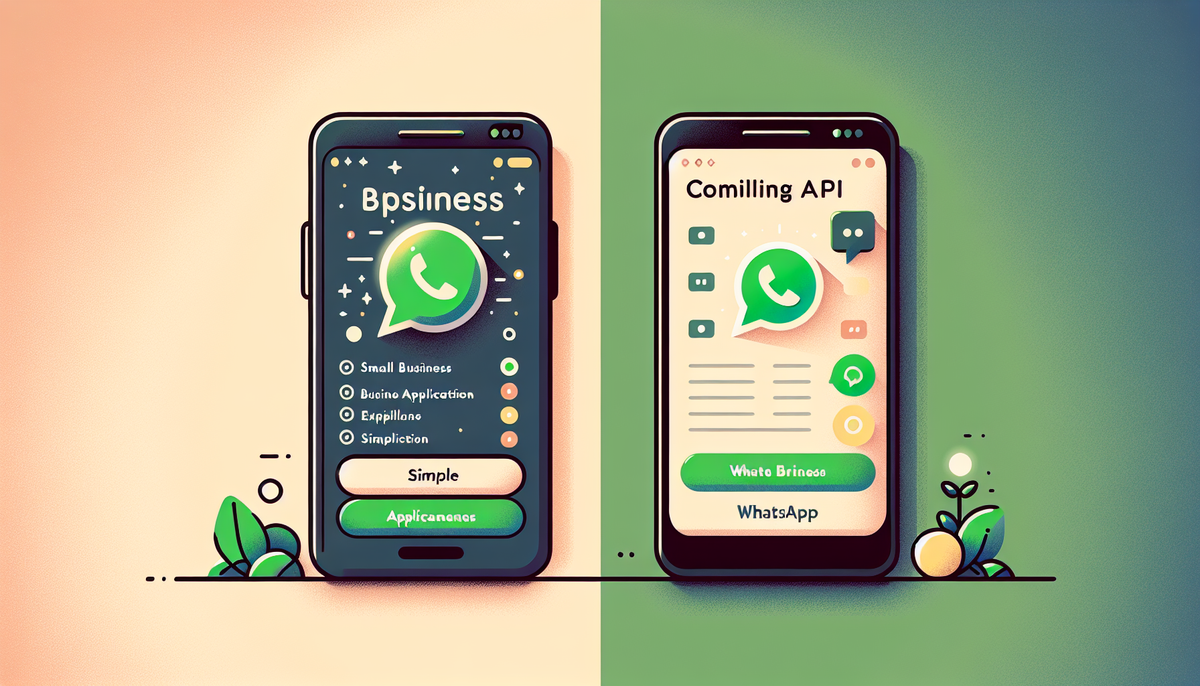
WhatsApp Business (the free app) works for solopreneurs and very small teams. WhatsApp API (via providers like Watsi) is what growing e-commerce businesses in LATAM need — it unlocks automation, AI agents, unlimited agents, and real sales data. If you're sending more than 50 messages a day, you've already outgrown the app.
What's the Actual Difference Between WhatsApp Business and WhatsApp API?
This is the question every LATAM e-commerce owner asks before they scale. Both products share the WhatsApp brand, but they serve completely different stages of business growth.
WhatsApp Business (the app) is Meta's free mobile app. It adds a business profile, a catalog, quick replies, and basic auto-messages like "We're closed right now." It runs on one phone, one person. You download it from the App Store or Google Play and you're done in 10 minutes.
WhatsApp API (officially called WhatsApp Business Platform) is the backend infrastructure that companies access through authorized providers. There's no app — it's a connection between WhatsApp's servers and your systems. It's how brands send thousands of personalized messages, run AI chatbots, assign conversations to multiple agents, and track sales attribution down to the message level.
The API is what Watsi is built on. When a customer messages your store and an AI agent responds, qualifies the lead, answers product questions, and closes the sale at 2 AM — that's the API at work.
Why the Free App Eventually Hurts Your Business
The WhatsApp Business app has real limits that feel fine when you're small and become painful fast:
- One phone, one user. You can't have your sales rep and your support person logged in at the same time — at least not without account-sharing workarounds that violate Meta's terms.
- No automation beyond basic templates. You can set an away message. That's about it. No flows, no bots, no dynamic responses based on what the customer said.
- No CRM integration. Every conversation lives in the app. You can't sync it to your Shopify store, your email list, or your ad campaigns.
- Broadcast limits. You can only message people who have your number saved. Broadcasts are capped at 256 contacts. Miss a day and you're manually re-uploading lists.
- No analytics. You have no idea which product questions lead to sales, which messages get ignored, or how fast your team responds.
For a business doing 10-20 orders a week, this is manageable. For a business doing 200+ orders a week with customer support questions flying in, the app becomes a bottleneck.
What Does WhatsApp API Actually Unlock?
When you connect via the API (through a provider like Watsi), you get access to the full commercial-grade infrastructure:
- Multiple agents, one number. Your entire sales and support team works from a shared inbox. No more "who responded to this customer?"
- AI-powered automation. An AI agent handles first-contact responses, qualifies leads with questions, recommends products, and escalates to a human when needed — 24/7, even during Mexican holidays.
- Unlimited broadcasts with segmentation. Send to your full customer database. Filter by purchase history, location, or product interest. Track who opened, who replied, who bought.
- WhatsApp Flows. Build interactive journeys inside the chat — mini-forms, product configurators, appointment booking — without sending customers to a website.
- Two-way CRM sync. When a customer buys, updates their info, or asks about an order, it syncs to your store backend automatically.
- Conversation analytics. Response times, resolution rates, sales conversion by campaign — actual data you can make decisions with.
The LATAM Context: Why API Matters More Here Than Elsewhere
In markets like Mexico, Colombia, Brazil, and Argentina, WhatsApp isn't just a communication channel — it's the primary commerce interface for a huge portion of the population. Research consistently shows that LATAM consumers prefer to buy through WhatsApp over web checkouts, especially on mobile.
That means your competitors are also on WhatsApp. The businesses winning in LATAM e-commerce in 2026 aren't just present on WhatsApp — they're automated, available 24/7, and turning conversations into tracked revenue. That requires the API.
A restaurant in Monterrey can take 300 orders per weekend through WhatsApp flows — with zero manual data entry — because they're on the API. A clothing brand in Bogotá can recover 40% of abandoned carts by sending personalized follow-ups within 30 minutes of abandonment. That's API territory.
How Much Does WhatsApp API Cost?
This is where people get nervous, but the pricing is more accessible than most expect:
- WhatsApp Business App: Free forever. No message costs, no monthly fee.
- WhatsApp API: Meta charges per conversation (a 24-hour window), not per message. Prices vary by country and conversation type (marketing, utility, service). In Mexico, marketing conversations are around $0.015 USD each. Service conversations (when a customer messages you first) are often free or very cheap.
- Platform fee: You pay the API provider (like Watsi) a monthly or usage-based fee on top of Meta's charges. This covers the inbox, AI agents, integrations, and support.
Most growing e-commerce businesses find that the ROI from automation more than covers the cost within the first month. One recovered abandoned cart campaign often pays for several months of platform fees.
When Should You Make the Switch?
You don't need to wait until things break. Here are the signals that it's time to move to the API:
- You're spending more than 1 hour per day manually responding to WhatsApp messages
- Customers are not getting responses within 30 minutes during business hours
- You have more than one person who needs access to the same WhatsApp number
- You want to run promotional campaigns to more than 256 people
- You're losing sales to competitors who respond faster or offer smoother buying experiences
- You want to understand your sales conversion data beyond gut feeling
If two or more of these resonate, the switch will pay for itself quickly.
Key Takeaways
- WhatsApp Business app is a great starting point for tiny operations — free, easy, enough for early days
- WhatsApp API (Business Platform) is the infrastructure layer that unlocks automation, multi-agent support, analytics, and real commerce capabilities
- For LATAM e-commerce businesses doing real volume, the API isn't a luxury — it's the infrastructure your competitors are already using
- Switching to the API doesn't require technical expertise when you use a managed provider like Watsi
- The ROI calculation is usually simple: time saved on manual messages + sales recovered from automation > platform cost
Next Steps
If you're ready to move beyond the app and start building a real WhatsApp commerce infrastructure, Watsi connects your business to the WhatsApp API with AI agents, a multi-team inbox, and campaign tools built specifically for LATAM e-commerce. No developers required to get started.
Most businesses are live and sending automated conversations within 48 hours of signing up.
About Watsi: Watsi helps LATAM e-commerce businesses sell more through WhatsApp with AI agents, automation, and a full conversational commerce platform.